Mice move indoors in Laurel on a schedule you can almost set a calendar by — the first stretch of cool nights in late September and October pushes house mice off the field edges and into foundations. In Old Town Laurel…
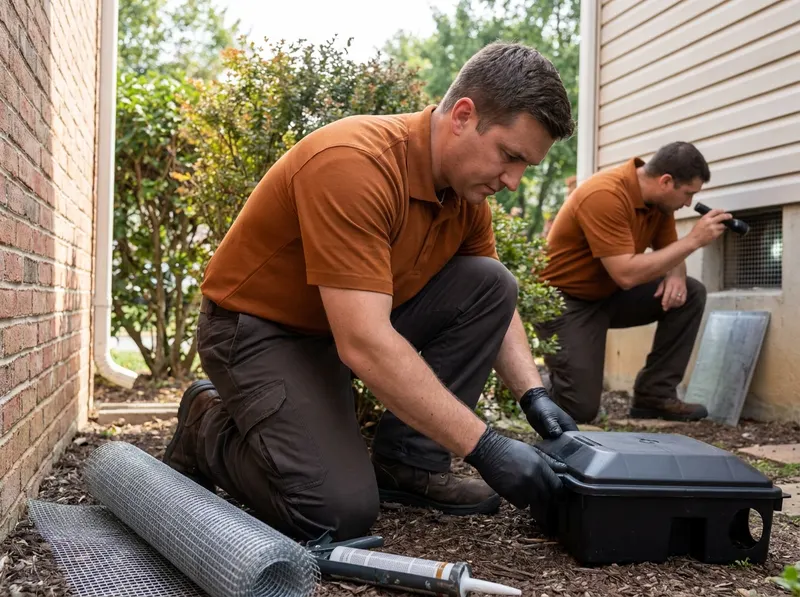
Mice move indoors in Laurel on a schedule you can almost set a calendar by — the first stretch of cool nights in late September and October pushes house mice off the field edges and into foundations. In Old Town Laurel and the older streets off Main Street, the entry points are usually low: mortar gaps in block or fieldstone foundation walls, sill-plate seams behind overgrown shrubs, gaps around old water and gas service lines, and basement window frames that have shifted. In newer North Laurel, Russett, Emerson and Patuxent Greens construction, the gaps are almost always at the same three places instead — the corners under the garage door seal, the dryer vent and A/C line penetrations, and the weep or utility gaps behind the siding. A mouse fits through a hole the diameter of a pencil, so a gap you would not notice while mowing is a working door.
Rats are a different job with a different search area. Norway rats in the Laurel area are outdoor burrowers first: we look for one-to-three-inch burrow openings along fence lines, under sheds and decks, in dense ivy, near compost and bird feeders, and along the low wet ground and drainage corridors toward the Patuxent — the kind of ground you see near Riverfront Park and along creek edges below Laurel Lakes. Rat control means finding and monitoring those burrows and closing off structural access at crawlspace vents, garage thresholds and grade-level gaps, not just putting a box of bait by the back door.
The decision most Laurel homeowners face is trapping-plus-sealing versus an ongoing exterior bait program. Trapping with exclusion is the option that actually ends an interior mouse problem, because trapped mice are removed from the house and sealed gaps stop the next ones. The trade-off is that exclusion is labor, it costs more up front, and on some older Bond Mill and Steward Manor foundations it takes staged visits to close everything. An exterior bait-station program is cheaper per month and fits properties with steady outside pressure — a wooded rear lot in West Laurel backing to trees, a shed and woodpile in Montpelier, a yard that borders open ground near the Patuxent Research Refuge — but it manages pressure rather than removing the reason rodents are getting inside.
Shared walls change the math again, and it is the part most companies skip. In Laurel and South Laurel townhouses, condos and apartment blocks, mice travel the party wall, the shared plumbing chase and the drop ceiling between units. Treating one interior in isolation usually just relocates the activity next door for a few weeks. We inspect the shared-wall path and the exterior of the whole building envelope, not only the unit that called, and we tell you plainly when the fix requires the neighbor or the HOA/management to get involved. We also tell you what we do not do: we do not promise a single spray cures rodents, and we place bait and traps with kid and pet safety as the deciding factor — tamper-resistant stations outdoors, mechanical traps in the living space wherever we can use them.
We cover Laurel addresses across Prince George's County and the adjoining Laurel-addressed parts of Howard and Anne Arundel Counties. Every ballpark on this page is a range, and the exact number is confirmed at your home during the free inspection, after the entry points are counted.
Every job gets a firm, written price after a free on-site visit.
Tell us about your rodent control (mice & rats) job in Laurel and we'll send a clear, written quote — usually the same day.
 Trevixa Pest Solutions