The decision most Laurel homeowners face is nest removal versus a broader pest plan, and the honest split is simple. If you can point at one nest — under the deck rail, in the gable vent, in a hole in the mulch bed — a…
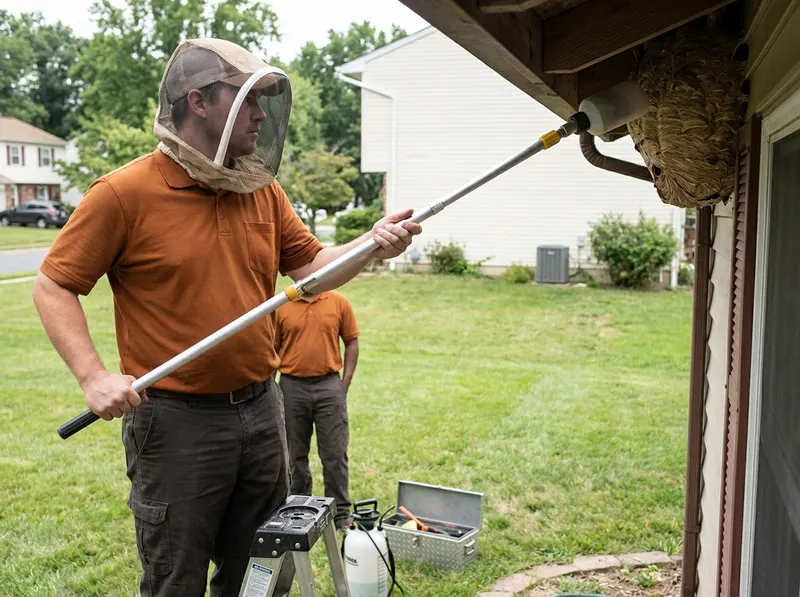
The decision most Laurel homeowners face is nest removal versus a broader pest plan, and the honest split is simple. If you can point at one nest — under the deck rail, in the gable vent, in a hole in the mulch bed — a targeted nest job is the right and cheaper call. If you're finding wasps inside the house with no nest visible outside, the problem is usually a colony in a wall void or soffit cavity with an interior gap, and that needs a full exterior inspection of the eave line, brick weep holes and utility penetrations rather than a spray at one hole. The trade-off on a single nest job is scope: we resolve the nest we find and any others we spot on the same visit, but we're not monitoring the property for new colonies through the rest of the season.
Laurel's housing stock creates predictable nest locations. The older porches and detached garages around Old Town Laurel and Bond Mill collect paper wasp nests on painted ceiling boards and inside garage door tracks — small colonies, easy takedowns. Vinyl-soffit homes in Russett, Emerson and Patuxent Greens hide yellowjackets behind the soffit and J-channel, where the only sign is a steady traffic line at a seam 18 feet up. In West Laurel, Montpelier and North Laurel, mature oaks, maples and wooded lot edges near the Patuxent Research Refuge produce bald-faced hornet nests and European hornets working tree bark at dusk. Ground yellowjackets show up everywhere there's loose fill: mulch beds, old vole runs, hollow retaining-wall block, and the gaps behind landscape timbers on the sloped yards off Rocky Gorge. In South Laurel and Steward Manor townhomes, a soffit colony often sits over the property line, so we'll tell you plainly if the entry point is on your neighbor's half of the shared run and needs their access too.
Timing is worth knowing before you spend money. Colonies are small and quiet in May and June, then peak in August and September — that's when a Laurel yellowjacket nest reaches a few thousand workers, gets defensive within about ten feet of the entrance, and starts crashing cookouts and trash cans near Granville Gude Park at Laurel Lakes and Riverfront Park. Late-season nests do die off after hard frost and are not reused the following year, so if you find an exposed nest in November on a shed you don't touch, waiting is a legitimate option and we'll say so. What we don't recommend is a can of aerosol at a ground nest or a wall void: hitting a colony from the wrong angle scatters workers, drives yellowjackets deeper along a wall cavity, and in shared-wall units can push them out through an interior outlet or light fixture. Ground and in-wall colonies are the two situations where DIY sprays most often make the problem worse. We treat at the entrance so returning foragers carry material in, wait for the traffic to stop, then remove the physical nest where a ladder can reach it safely — because an abandoned paper nest and an old comb in a soffit still attract carpet beetles and dermestids.
One more piece of the diagnosis we won't skip: not everything that stings needs treating. Cicada killers, which are large and dramatic on Laurel lawns in July, are solitary ground wasps that rarely sting people, and carpenter bees drilling deck rails are a wood problem, not a colony problem. We tell you which insect you actually have before quoting the work — identification first, then the fix.
Every job gets a firm, written price after a free on-site visit.
Tell us about your wasp, yellowjacket & hornet nest removal job in Laurel and we'll send a clear, written quote — usually the same day.
 Trevixa Pest Solutions