Eastern subterranean termites are the species that matters in Prince George's County, and they travel through soil, not air — which is why station placement is the whole job. Stations go in the ground at intervals…
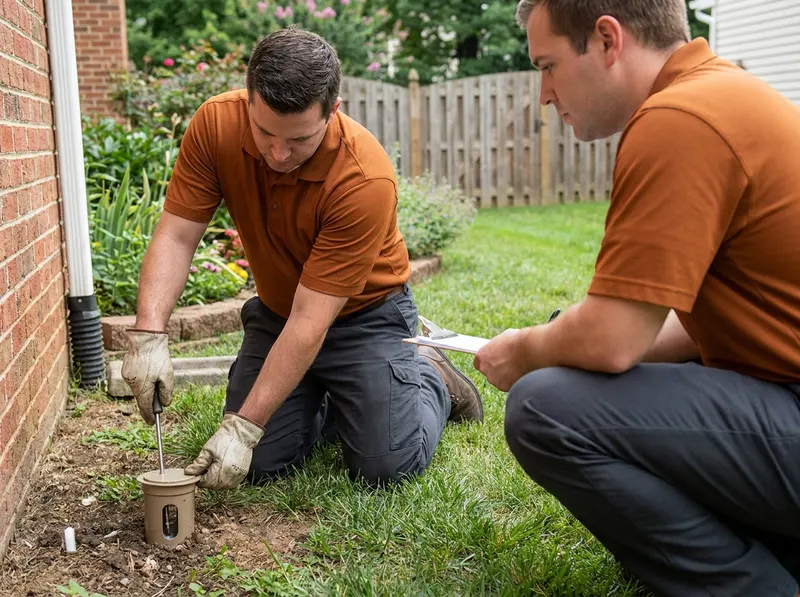
Eastern subterranean termites are the species that matters in Prince George's County, and they travel through soil, not air — which is why station placement is the whole job. Stations go in the ground at intervals around the foundation, typically 8 to 12 feet apart, with extra placements at the spots where termites concentrate: mulch beds against brick, downspout splash zones, deck posts set in soil, tree stumps, fence lines, and the shaded north side of a house that stays damp for days after rain. On a walk-through we count the stations the property actually needs and mark why each one is where it is. A station in the wrong place reads clean while termites feed six feet away, so the map matters more than the station count.
Bait monitoring fits some Laurel properties better than a liquid soil treatment, and the trade-off is honest. A continuous liquid termiticide trench requires digging and drilling a complete line around the structure — hard to achieve on the older homes near Main Street Laurel and Old Town where porches, brick stoops, and slate walkways interrupt the perimeter, and something homeowners in West Laurel near the Rocky Gorge Reservoir often want to avoid because of well proximity and wooded, root-filled soil. Stations work around hardscape, need no trenching, and use a small amount of bait matrix rather than a soil-volume application. The trade-off: baiting works on the colony's schedule, not yours. Termites have to find the station and recruit to it, so it is a long-game program. When swarmers are already coming out of a windowsill in a Montpelier-era home in March or April and there is visible damaged wood, a liquid barrier or a targeted structural treatment gives faster knockdown, and stations become the follow-on monitoring layer.
Monitoring is also the practical answer for the housing types Laurel is full of. In townhouse rows in Russett, Emerson, and South Laurel, the accessible perimeter is short — front bed, rear patio, and two ends — so a station line is cheaper to install and quicker to read, and a documented monthly-to-quarterly record is useful when an HOA or a neighbor's unit is involved. Slab-on-grade construction in North Laurel and Patuxent Greens hides the first evidence entirely, since there is no crawlspace to inspect; stations become the early-warning system the slab denies you. In Bond Mill and Steward Manor, older basements with earth-contact wood, sump pits, and stored cardboard give us specific interior points to check on the same visit.
Every visit is read and written down, including the clean ones. A monitoring program with no records is just stations in the dirt. We log station-by-station findings, note new moisture or grade problems we see along the foundation, and tell you plainly whether the reading calls for bait replacement, added stations, or a different treatment approach. That is the order we work in: identify it first, then end it.
Every job gets a firm, written price after a free on-site visit.
Tell us about your termite bait station monitoring job in Laurel and we'll send a clear, written quote — usually the same day.
 Trevixa Pest Solutions